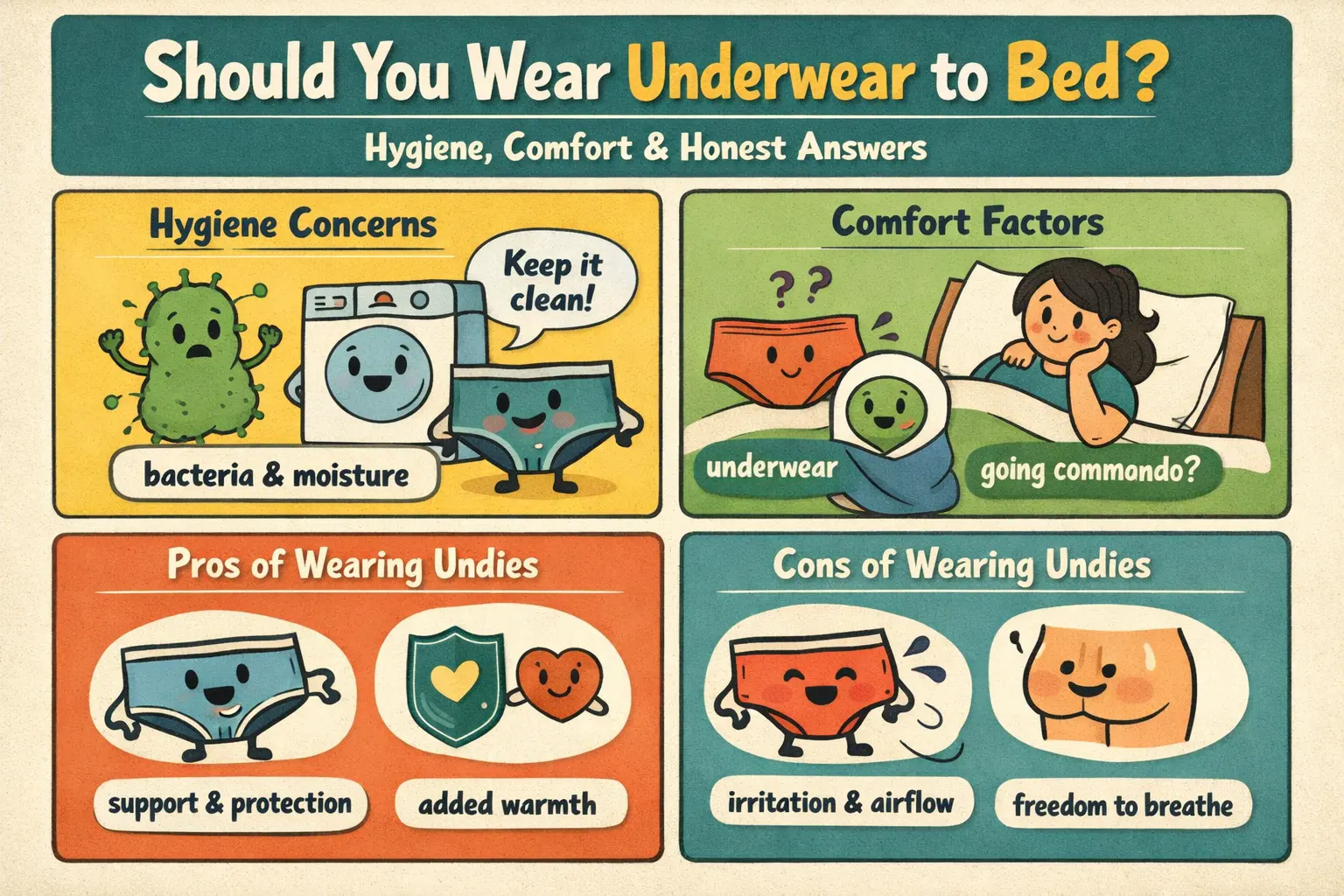
For most people, sleeping without underwear is the best default: it improves airflow, reduces heat and moisture build-up, and lowers friction on skin. If you do wear underwear to bed, choose loose, breathable cotton and avoid tight synthetics. The exceptions are practical ones: periods, discharge, incontinence, cold rooms, certain skin conditions, or anything that needs a protective barrier. Guidence from the pros consistently supports this “sleep without underwear” approach.
The short version
Best for hygiene and skin: sleep without underwear, or in loose pyjamas/shorts.
If you wear underwear: loose fit, cotton, clean pair, no tight elastics, no lace rubbing against places that don’t appreciate decorative scratching.
Do wear underwear at night if: you’re on your period, you have discharge you need to manage, you’re using topical treatments, you leak urine, you’re in a cold house, or you need a barrier for comfort. No shame, just logistics.
Stop guessing and change approach if: you wake up sweaty in the groin, itchy, irritated, or you get recurrent thrush, BV, rashes, or chafing. Your body is sending you strongly worded letters.
Support for breathable cotton and avoiding tight, sweaty, non-breathable fabrics is consistent across vulvar care guidance from medical experts.
Why this is even a debate?
It feels like underwear equals “cleaner”, doesn’t it? Like you’re somehow more civilised, more put-together, more respectful to your bedsheets if you’re wearing a tiny fabric barrier between you and the night.
Turns out the science of skin is mostly about moisture, friction, and airflow, not moral virtue or your grandmother’s opinions about propriety.
“Hygiene” at night is often just: keep the area dry-ish, un-irritated, and not overheated. Revolutionary stuff, truly.
The science bit, explained like a normal person
Heat and sweat: your body warms up at night, whether you like it or not
Sleep is tightly linked to thermoregulation, which is a fancy way of saying your body spends all night trying to work out if it’s too hot or too cold. Your body’s temperature regulation shifts during sleep, and your environment and clothing strongly influence sweating patterns.
If you trap heat around the groin with tight underwear or synthetics (looking at you, that pair from 2019 that’s 95% polyester and questionable life choices), you create a warm, damp microclimate. And damp plus warmth is exactly what many microbes absolutely love. They’ll throw a party down there.
Moisture: the real reason “breathable” underwear keeps coming up
Yeast and bacteria thrive more easily in warm, moist environments, which is why cotton and looser fits are so commonly recommended for vulvovaginal comfort and to reduce irritation risk.
This isn’t a moral judgement on your underwear choices. It’s just biology being annoying, as usual.
Friction and pressure: the underrated cause of itching and rashes
Tight underwear means more rubbing, more pressure on sensitive skin, and more irritation. It’s like wearing a very small, very persistent grudge against your own comfort.
Multiple clinical vulvar-care resources specifically advise avoiding tight underwear and often recommend sleeping without it.
So, is it more hygienic to sleep without underwear?
Yes, for most people. Not because underwear is “dirty” (though if yours is, that’s a separate conversation), but because airflow and dryness matter.
Mayo Clinic resources recommend breathable, cotton underwear and also suggest sleeping without underwear or wearing loose clothing to reduce irritation and moisture build-up.
University of Iowa Health Care vulvar skin care guidelines explicitly advise not wearing underwear when sleeping. They said it, not us. (Well, we’re saying it too, but you get the point.)
When wearing underwear to bed actually makes sense
Periods, spotting, postpartum bleeding
If you need a pad or period underwear, obviously you need something to hold it in place. Unless you’ve mastered the art of adhesive pads that stick directly to bedsheets, which sounds like a nightmare for everyone involved.
Best practice: prioritise breathability and change in the morning. Your future self will thank you.
Discharge you want to manage
If discharge is heavy enough to bother you, a thin liner plus cotton underwear can be practical. This is just sensible housekeeping for your body.
If discharge has a strong smell, itching, pain, or changes colour significantly, that’s a “check it” sign rather than a laundry problem. (Your GP or sexual health clinic is the move. Dr Google is not qualified.)
Incontinence, sweat, or medical reasons
Night-time urinary leakage, groin sweat, or topical treatments may require a barrier layer. Bodies are messy sometimes. It’s fine.
In those cases: loose cotton underwear, and consider changing right before bed so you’re not sleeping in yesterday’s decisions.
Cold bedrooms
Comfort counts. If underwear keeps you warm and you’re not getting irritation, it’s fine. Purity culture can take a seat; you’re just trying to sleep without shivering.
What to wear if you do sleep in underwear
Fabric rules
Pick: cotton (or at least a cotton gusset), soft seams, breathable weave. The boring choice is the correct choice here.
Avoid: tight synthetic blends if you’re prone to irritation, sweatiness, or thrush symptoms. Save the fancy lace for when you’re awake and vertical.
Fit rules
Loose enough that it doesn’t dig in. If you wake up with marks, chafing, or dampness, it’s too tight or too non-breathable. Your underwear should not be leaving evidence of its existence on your skin like some sort of textile crime scene.
Laundry and detergents (quietly important)
Some vulvar-care guidance suggests avoiding harsh detergents, fabric conditioners, and biological products if you’re irritation-prone.
Basically: if your underwear smells like a spring meadow crossed with a chemical plant, you might want to dial it back.
What about men? Comfort, sweat, and the fertility question
If you’re trying to conceive, there’s evidence that looser underwear is associated with better sperm parameters in at least some populations, and scrotal temperature is a plausible mechanism.
Honest bottom line: sleeping without tight underwear is a sensible, low-effort choice if fertility is on your mind, even if it’s not a magic switch. (Spoiler: nothing about conception is a magic switch. If it were, we’d all know about it by now.)
Myth-busting section
“Sleeping without underwear is unhygienic”
Usually the opposite, as long as you have clean sleepwear/sheets and basic washing habits. Airflow helps. Your genitals can breathe. They deserve that, frankly.
“Underwear at night prevents infections”
Not generally. Breathability and dryness matter more than “having a layer”. Thinking of underwear as an infection shield is like thinking a tea towel protects you from house fires.
“Going commando causes infections”
Not by itself. Problems usually come from sweat, friction, irritants, and not changing out of damp clothes. Going commando is not the villain in this story.
Practical decision guide
Try sleeping without underwear for 2 weeks if any of these are true:
- You wake up sweaty in the groin
- You get chafing, redness, or itching
- You’re prone to thrush-like symptoms
- You wear tight leggings or shapewear a lot during the day (your body needs a break)
Keep underwear at night (but make it cotton and loose) if:
- You’re on your period
- You need a liner, pad, or protective layer
- You have leakage or are using medication that stains
- You’re cold and it helps you sleep
Clinical and healthcare guidance strongly backs the “loose, cotton, avoid tight, and often sleep without underwear” approach for vulvar comfort, according to Mayo Clinic, University of Iowa Health Care, and ACOG.
Troubleshooting common scenarios
“I sweat loads at night”
Reduce layers around the groin. Consider a cooler bedroom and lighter sleepwear. Maybe stop sleeping under that duvet meant for Arctic expeditions.
If you have drenching night sweats or other symptoms, consider a medical check because night sweats can have many causes. Sometimes bodies are just dramatic, but sometimes they’re trying to tell you something.
“I get itchy at night”
Swap to sleeping without underwear. Switch to fragrance-free laundry products. Avoid tight fits and scratchy seams. Your skin shouldn’t feel like it’s being gently tormented all night.
“I keep getting ‘thrush’”
Recurrent symptoms are often mislabelled. Get properly checked if it keeps happening.
In the meantime: keep things dry, avoid tight synthetics, prioritise cotton. And stop diagnosing yourself via internet comment sections.
How this ties into packing and the Underpants Calculator
More sweat at night equals more pairs needed on a trip. Hot climates, humid destinations, hostel dorm heat, and heavy walking days all push you towards more frequent changes.
If you’re the sort of person who sleeps in underwear every night, factor that into your packing. If you’re going commando, congratulations: you’ve just reduced your luggage weight by approximately 200 grams. (Every bit counts when airlines are being petty about bag weight.)
Our calculator helps you avoid having to think about how many pairs of underwear you’re going to need on your trip.
FAQs
Is it healthier to sleep without underwear?
For most people, yes. Better airflow, less moisture, fewer opportunities for irritation to set up shop.
Can sleeping in underwear cause thrush or BV?
Not directly, but tight, synthetic underwear can create conditions that make infections more likely. It’s the environment, not the fabric itself plotting against you.
What should I wear to bed if I sweat a lot?
Ideally nothing around the groin area, or loose cotton if you must. Light, breathable sleepwear. A cooler room if possible. Definitely not your gym leggings from earlier.
Should I sleep without underwear during pregnancy?
Unless you have a specific medical reason to wear it, going without is generally fine and often more comfortable. Pregnancy is uncomfortable enough already.
Is it bad to sleep in tight boxers/briefs?
If you’re trying to conceive, it’s worth switching to looser options. If you’re waking up sweaty or irritated, also worth switching. Otherwise, it’s probably just mildly suboptimal rather than actively harmful.
What’s the best fabric for night-time underwear?
Cotton. Always cotton. Or at least a cotton gusset. This is the one time boring is correct.
Final verdict (clear and boring, in a good way)
If you want the most hygienic, lowest-drama option: sleep without underwear. Your skin will thank you, your laundry pile will shrink slightly, and you’ll have one less thing to worry about at 3am when your brain decides to catalogue every poor decision you’ve ever made.
If you need underwear for practical reasons: keep it loose and cotton, and treat “waking up damp or irritated” as the sign to change approach.
Is this revolutionary advice? No. Is it correct? Yes. Will you actually follow it? That’s between you and your underwear drawer.
(Probably won’t, but we tried.)
Leave a Reply